YouTubeが低評価数の公開を停止したため、Return YouTube Dislikeプロジェクトによる推定値を表示しています。 returnyoutubedislike.com
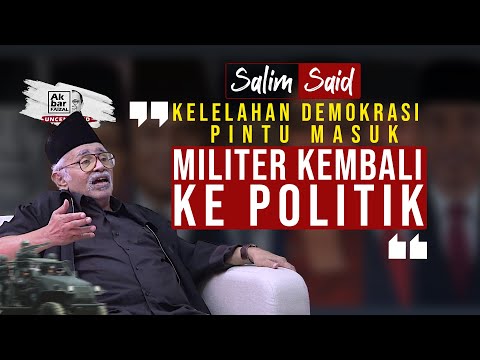
is Jokowi facing debt collectors? Well, that illustrates that Jokowi actually owes a debt to many oligarchic powers. So what Jokowi is facing, what we now call the oligarchy, are the creditors who lent to Jokowi so he could become president. One of the guests most requested by AFU viewers is Professor Salim Said, and I had to wait months for his schedule to bring him here. He is busy preparing many things. I heard earlier there's a plan to speak at a
forum in America. Um, today we succeeded, and I am sure the topic will be engaging because I will ask many things. I hope Professor Salim's memory can recall them in detail. Prof, thank you, Prof, for coming to our place. Thank you. It is an honor for me. So, even though my health is not perfect, I felt it necessary to come to your studio this morning. Thank you. Yes. Thanks, Prof. Because, viewers, as you know, his background is vast; he
was once the head of the Jakarta Arts Council when I first arrived in Jakarta in Cikini, but he is known as a senior journalist who even covered the Bung Karno era. And later became the ambassador to Czechoslovakia. Was it still Czech or Czechoslovakia? Czech. Oh, it’s already Czech, right? It has split into two, Czech and Slovakia. Yes. That beautiful city of Prague. But today we invited him here to discuss,
Prof, how this country is managed. Akbar Faisal Uncensored is a medium for ...what? Information and learning, as well as a medium to speak to everyone. As part of the Negara Institut, an institution I founded here. Prof, as I mentioned earlier, we want to know how the state of Indonesia, as I call it, was born, grew, moved forward, and solved its problems. I want to give a slightly long introduction, that in Bung Karno's time, this nation moved
with all its problems as a new nation, a new state. I mean, how those political problems crystallized not in individuals, but through parties. They fought, and so the PKI and all that happened. Did we fail to solve the problems during the Bung Karno era? In Pak Harto's era, there were also problems; Pak Harto perhaps succeeded in consolidating political parties, even forcing them to fuse into only three parties. But economic problems
emerged that, it turns out, still have an impact today. What is that? Political tentacles based on business. The business interests of the groups around Pak Harto ultimately failed to consolidate because he fell in '98, entering the Pak Habibie era. Pak Habibie did not have enough time and political power to solve the problems because he was part of the New Order problem called Pak Harto. So, his accountability report was rejected, and
he did not continue. I don't want to use the word "fell," but his administration did not continue. Then we entered the Gus Dur era. Gus Dur, with all his controversies and the major legacy of pluralism he championed , ultimately fell as well. Mrs. Megawati, Mrs. Megawati continued the administration of Mr. Gus Dur. Mr. Gus Dur, but did not continue into the next term. There are some analyses
suggesting it was because he couldn't consolidate political forces, which failed to become a political advantage for him, leading to his exit. We can debate that point. Moving on to the SBY era. The 10-year SBY era. Did democratic consolidation succeed during the SBY era? Hmm, I'm doubtful. Or did he fail? I'm doubtful about that, too. The problem is that Mr. SBY wanted to please too many parties, so nothing ended up being resolved. In terms of
the economy, we saw an "economic bubble " considered normal, even though it was not. Moving on to Mr. Jokowi. Mr. Jokowi successfully accomplished something that is now remembered as infrastructure. Is it fair to call infrastructure a success? It could be. Yes, it could or could not be. But in terms of democracy, Mr. Jokowi's administration managed to consolidate the parliament up to 82%with the entry of PAN. The question for Mr. Jokowi is,
did democratization succeed with that pattern, or was it a failure? Professor , please allow me to apologize. I gave such a long introduction, but why? The person I am facing has a very long track record. You have been a journalist since the era of Bung Karno. My question is, how do we understand and see this nation getting out of its problems so we can learn from those processes? Please. That question of yours is long.
Yes. And the entire material of my course on Indonesian politics and society is contained right there. Okay. So I always start my political lectures by tracing the historical journey of this nation. Okay. I always say this Indonesian nation is a new nation, a a man-made nation, because in the 19th century, there was no Indonesia. Okay.
Especially during the Majapahit era, or the Sriwijaya era. So this is a new what? A new phenomenon, right? And its development is very rapid. Okay. In what year was Budi Utomo? '08 or '09 . Okay. Sarekat Islam and so on. Then there was the Youth Pledge, which is important because all the sectarian groups at that time—Jong Java, Jong Sumatranen Bond, and so on— transformed into Indonesia Muda after
the pledge. So, Indonesia had already appeared and become established. I don't want to get too detailed about who first used the name "Indonesia." Okay. But one important point there is that it wasn't automatic that after Indonesia Muda and the growth of political parties, the concept of Indonesia was already established. Okay . Okay. So, in its development, the
Japanese occupation occurred, then the proclamation of independence, and formally there was Indonesia, with Soekarno as president and Hatta as vice president. That is the problem caused by the political reality that only once , after that Youth Pledge, after Indonesia Muda...new, and then those new goods were consolidated by Japan into a country, then becoming the independent country of Indonesia. Okay.
Okay. Now, along the way, the past experience showed that people in Indonesia needed a long time for consolidation, both sociologically and politically. Okay. Okay. Now, we see that tension emerging again in the 50s. Parliamentary, cabinets rising and falling and so on. Yes. And various things. The PKI wanted one thing, the Muslims wanted another, the secular people wanted something else.
Now, the interesting part here is when Soekarno entered. Soekarno had a great contribution to the proclamation. Okay. Okay. But Soekarno was very disappointed seeing the results of the proclamation. Okay, you will see later that General Nasution was also involved there. So don't be surprised that the push for Soekarno to return to democracy, giving birth to guided democracy, that declaration happened
with Nasution's support. Hm. Now, Nasution was the leader of the army who was also dissatisfied. Hm. So, there were two major political forces. Nasution represented the army, especially the land forces, and Soekarno was himself. Their cooperation . Guided democracy. What happened? Then in that guided democracy, there was a dynamic concerning Soekarno himself. Soekarno became very important because
he was the executive president. During the era of liberal democracy, the parliamentary government that rose and fell, Soekarno was just a symbol. But he was still influential because, historically, he was an important person. Now, after returning to the 1945 Constitution for guided democracy, Soekarno wanted to implement his concept. One of his tragic concepts was NASAKOM. This is what eventually led to Gestapu. Gestapu, the Gestapu event,
was the beginning of Soekarno's fall. He. Okay. So, Soekarno fell, guided democracy ended, it ended formally. I remember well as a young journalist, as a young intellectual, in the early days of what was later called Pancasila democracy. We intellectuals, including the younger ones, warned not to let the New Order be a, what do you call it, democracy minus the PKI. Hm. Okay. Now, what happened was that.
Many things were achieved by Soeharto because Soeharto was powerful. Why was he powerful? He didn't need a party. So Golkar wasn't actually important. What was important was the military support for Pak Harto. For Pak Harto. So Soeharto was strong not because of Golkar. Golkar got a place in parliament because, what do you call it? Uh, its duty was for Golkar to occupy seats in the DPR to provide legitimacy to Soeharto. But
Soeharto's strength was the army, in the TNI. TNI. Okay, with that, Soeharto controlled everything. So don't be surprised that the beginning of Soeharto's fall was when the army was secretly, well, not only secretly. If you notice, Sumitro, the former commander of Kopkamtib, had long been a pioneer in criticizing Pak Harto. Soeharto. So, Soeharto's rise and fall
were because of the army. Yes. Okay. Because the 98 riots had actually happened many times before. Malari, for example, Soeharto remained firm because he was supported by the military. When the military repented after seeing that they couldn't control Soekarno and Soeharto, they secretly supported the forces critical of Soeharto. He fell. Fell again.
Okay. So the fall was because he didn't have any support left, right. Note Wiranto's words to Pak Harto on the night he was about to step down: that Soeharto was legally still in power but politically finished. Finally, Soeharto relented. Now, because he didn't want any trouble , he resigned and was replaced by Pak Habibi. Pak Habibi was, as you said earlier, the heir to Soeharto's power. And
frankly, I happened to be close or was once close to Pak Habibi, exchanging thoughts several times. Pak Habibi basically did not understand. He didn't understand Indonesian history, he didn't understand Indonesian politics. So, and he didn't understand and didn't know how to play politics. The proof is that he resigned. Even though actually, if he wanted to hold on, he could have held on. But he didn't have enough political experience. All this time,
since he returned from Germany, he was constantly spoon-fed by Soeharto. Yes. He didn't have political experience by himself. So I can understand that after he was rejected by the MPR, he immediately quit. Even though, in reality, that's not the end of the game . Yes, like that. But he was someone who didn't get a proper political education
. He was just fed things by Soeharto for years like that. Now, that journey brings us now to Gus Dur. Gus Dur was ill. Don't ask too much of Gus Dur. He was a good man. A good person to this nation and to his friends. One day in the fasting month, I was asked to come by Gus Dur. His secretary called me. So I went to the palace. I met him close to the time of breaking the fast. Before I was received by Gus Dur, Gus Dur met with Wijoyo and the others.
After they came out, I was invited to enter. The meeting was brief. Gus Dur said he was, what? He was encouraged by friends to utilize Salim Said. Gus Dur said that according to Yuwono to me. Yuwono Sudarsono, my senior at UI back then. Because Yuwono was the Minister of Defense. Then Gus Dur said, Gus Dur's message was, "If it's about the military, just ask Salim. He is the most knowledgeable among us." Okay. So then, one day I was at a seminar at the
ABRI Headquarters in Cilangkap, I was called by at least two people after that cabinet meeting which I came to the palace for. He asked me to become the first civilian governor of Lemhannas. Okay, interesting. I refused simply. I always remember my father's message, " Don't carry a burden you cannot bear. You will be in chaos. I refused to become the governor of Lemhannas." So, I was called again after the cabinet
meeting because, according to my friend who is a minister, the meeting participants said Gus Dur needed a military advisor. Okay. Then Gus Dur agreed and he mentioned he agreed on Salim Said. Okay. So, as soon as the cabinet meeting finished, I was called by Luhut Panjaitan what now? LB LBP and uh who? The Minister of Health, my old friend from UI, told me, "Lim, you've been appointed by Gus Dur, don't
refuse." Yes, I still remember those words from Luhut, don't refuse. Okay. But not long after, I waited a long time but never heard anything. Hmm. Did someone sabotage it or did Gus Dur forget? Forgotten. Forgotten. It never happened. Yes. Then one night there was a call from Emil Salim. Emil Salim.
There was one other person, I forgot. The message was, "Bung, you must be willing to become Minister of Defense." Juwono is sick. Me. My answer was clear . I don't even think about that. I am not interested. Okay. Then came uh Mahfud. Mahfud came to Jakarta. He was confused because it wasn't clear if he was the Minister of Defense or Land Affairs. Yes. Yes. So he asked to meet me,
there was a place owned by the Ministry of Defense, right. He was put up there before being inaugurated. So I gave him a briefing. He had no idea at all. What is this military business? So I am the only Indonesian who wrote a doctoral thesis on the political role of the TNI . Yes, for that, I received an award from Jaya Suprana as the first Indonesian to write a doctoral thesis on the military. Actually, there were others. I was the first Indonesian to
write a doctoral thesis on the history of Indonesian film politics. Hmm. So I have two uh what do you call them? uh what are those works called yes, those that got large plaques from yes yes, but it is quite unique, right, one is military, one is film. Because okay the film one was because when I graduated from Social Sciences UI I was
looking for a thesis topic I could write quickly, I didn't have much time, right. Yes. Juwono was the one who said, "Uh, write about film, you've been following film developments for years and no one else is doing it." Yes. I so I did research at the museum, interviewing many people. Finally, I wrote it and it became a book that was
published and later translated into English, something like that. Okay, that is roughly my journey. I have told you most of it, um, in studying Indonesia. Hmm. Yes. So, until Gus Dur's era, right? No? I continued to participate, even until today, my last book regarding Indonesian politics is called, ah, I keep forgetting. Uh, who, Jokowi
against the corruptors. Hmm. Wait a minute, Prof. What are your notes, Prof , regarding what we discussed earlier about how in the era of, what's its name, Bung Karno? I then Pak Harto, then Gus Dur. Now, after that, what are your notes regarding Megawati? It’s like this. Earlier I mentioned that I was a participant in a seminar on Indonesia in America, and I wrote a paper about
the consolidation of democracy in Indonesia. Okay. So I had to explain in context how the TNI, as a political force, was used by Soeharto to become Soeharto's power. Yes. And at one point, the TNI could no longer bear that burden. They began to protest, and that was the beginning of the fall of Soeharto. Soeharto. Okay. Then, after the seminar
had passed, it had just passed Gus Dur and Megawati. I concluded earlier that Gus Dur was ill. Okay. Many of his actions were strange. Nowadays, people might not imagine it anymore. But in those days, it seemed funny, yet the burden was heavy. So, the main supporter of Gus Dur to become president was initially Amin Rais. Yes, I explained that in my long interview with Amin Rais regarding that. Why did they support Gus Dur after Habibie was
rejected? Okay. Well, the conclusion is that neither Gus Dur nor Megawati were skilled at politics. How could Mega, having become president replacing Gus Dur, fail to utilize her position to get re-elected? The consequences were long-lasting, and to this day, the one who succeeded in replacing Mega at that time was SBY. And that created—I don't know why— such a deep wound for Megawati that, until today, Megawati cannot make peace
with SBY. SBY, as I recall, they met or were in the same place. When Mrs. Ani Yudhoyono passed away, I saw Ibu Mega at the cemetery. Ibu Mega and Puan Maharani were sitting in the distinguished guest area. Did she shake hands there with, um, who? SBY. I don't know because there were so many people. I myself didn't even have the chance to shake hands to express
condolences to SBY. For you, Professor, how was the 10-year phase under SBY? Was his government one that could be called successful and one that strengthened democracy or not? There is a lot of debate about that today. Yes. The most prominent thing in my opinion is that SBY is a good person. Okay. He wants to please everybody. He wants to please everyone.
Yes. Whereas there is an English saying that goes those who want to please everybody will end up pleasing nobody, right. But on average, the situation was safe. There were no major upheavals during SBY's era, and he was humble enough to follow democratic methods. For example, when that politician from Solo—what was his name? made a statement regarding SBY personally, SBY personally came to complain to the
police. He did not use his power as president. Yes, some people who were used to seeing a head of government use their power were a bit disappointed. Yes. But actually, SBY wanted to show that as a president, he is different; as a person, he is different; he felt personally hurt by—what is his name —that person from Solo. Even that person later joined his party, SBY's. Yes. I now it’s not heard anymore.
Yes. Exactly. What about Mr. Jokowi? Well, my book, you should read my latest political book about, uh, what, Jokowi uh facing debt collectors. Now, that illustrates that actually Jokowi is in debt to many oligarchic powers. So what Jokowi is facing, which we now call, uh, oligarchy, are the creditors who lent to Jokowi to become president. So, if in your introduction earlier you said,
you told a long story, uh, about Jokowi , Jokowi was lent to by the people called oligarchs. Now, Jokowi's strange actions, for example giving huge power to Luhut, LBP, that must be seen as those people collecting their debts from Jokowi, and Jokowi continues to be lent to. What is the relationship between Luhut Binsar Pandjaitan and the creditors? Isn't Mr. Luhut just one person among other people around Mr. Jokowi? And maybe Mr. Jokowi feels Mr.
Luhut is one of the few ministers who can solve problems, so he receives those authorities. Yes, that’s actually what should happen; after he was lent to become president, one of the big creditors was Megawati. And she was not sincere. If you read my book, it is clear that Megawati was not sincere in supporting, uh, Jokowi. But at that time, survey results showed that if Mega faced Prabowo, she would lose.
Hm. So the elders what is it called, uh , PDIP, the most prominent one being Sabam Sirait, the deceased, the deceased, yes, he told me—we were friends, Sabam, from when he was a member of, uh, what, what office, what office is it now, the presidential advisor, what is it called, uh, DPA, Timres, formerly DPA, DPA, I knew him well, he was very open,
we exchanged information, he said to me , "I told Mega, 'That's it, Mega, you won't be elected again.'""You should support Jokowi." Reluctantly, with reluctance. Finally, Mega accepted that and cast her support for Jokowi. But she never, she never, Megawati was never, uh, sincere. Just look at her comments about "the skinny one.""The skinny one" means Jokowi, and other things like that. To someone who wants to study politics, that is a political
statement. Remember, there was a time when PDIP members of parliament ganged up on Jokowi. I still remember it very well. And Megawati did not defend Jokowi. She was not sincere in accepting Jokowi. Exactly. I don't need to go into details. Let's just speak from memory; we all remember that. Yes. That’s why, uh, Prof, we can see that. Uh, I really should read Prof. Salim's book, it seems. But like in my long opening earlier, in Mr. Jokowi's
phase, there was one event that I think was surprising because it happened for the first time. What is that? Democratic consolidation? In Mr. Jokowi's regime version, it was then translated in a way that turned out to be very far. I use the word "very far." What is that? The power of political parties. The power of political parties in parliament was unified, only to become
very, very fat. 82%today. Yes. With PAN joining in. I'll refresh my previous question, Prof. Is this good for us? Or rather, if not good, it shows the character of our politicians to just jump in. This also happens. It stands out with the two figures who competed against Jokowi , Prabowo and the tourism minister. Uh, Sandiaga Uno. Sandiaga Uno. Amen. For me, it’s
surprising how his supporters must feel , those who once fought hard. To make Prabowo and whoever that is. Sandi. Sandi, why did they suddenly and easily become members of Jokowi's cabinet? Yes, it does strengthen Jokowi’s supporters. But for Indonesia's political process, I think that is not democratic consolidation. It is more of a consolidation of Jokowi's power, and Jokowi is getting stronger. His children wouldn’t be
mayors of Medan and Solo if he weren't strong. But that carries a heavy risk. Can Jokowi maintain his power after he steps down? Once his presidency ends, I mean. And those children becoming mayors in Medan and Solo was due to the support of the political parties you mentioned, that...what, 80-something percent? 82%. That is not a good example. We are a nation that just held an MPR session
with a decision to fight corruption, collusion, and nepotism (KKN). Fine then. Why do we have a president where the KKN is so blatant? His child, with only experience selling martabak, becomes a mayor. Then there’s one in Medan, whose political career we never even heard of, becoming the mayor of Medan. For Indonesia's political education, consolidation like that is very damaging to the journey of democracy in Indonesia.
There is one argument that we seem to need to consider as well, Prof. What is that? Regarding this situation, it is that the government needs political stability. Political stability so that big agendas can then be carried out. That. Nothing can move forward if political fighting continues to be loud and noisy . What can be done? Is that necessary? It needs to be considered like this, I
...you remind me of General Sumitro, the Pangkopkamtib. I was in an event, he explained as Pangkopkamtib he suppressed here and there to ensure what? Calm and order to build. What happened? The calm, order, and stability created by Kopkamtib were used by Soeharto to stay in power. Hm. We have that experience. "Oh, don't let this tension happen." Oh, so I remember well how Sumitro talked, his hands were like this. Was it successful? It
succeeded in making Soeharto stronger and he lasted 32 years. I think my count was 30 years. What? So, it means we have experience in maintaining calm, order, and stability à la Soeharto, and it turns out he misused it and became the victim. Do we want to repeat that? I'll flip it, Prof. I'll reverse the approach or the way of looking at it. Even if the president wants to unite these forces so that no one interferes with his government. And in
my view, in terms of political power calculations, that is only natural. Even though you previously considered that an anomaly, it still depends on the party, the party that is joining. Yes. If the party doesn't want to, they could just say no. You are a party person, yes. You were once a member of the DPR. You know the people, you are familiar with
them. Just look at how people who once built PAN with Amien Rais so easily tried to become a force that joined Mr. Jokowi. There is simply no morality. Why didn't they wait to fight and strengthen the party for the upcoming elections to fight again? Instead of looking for safety and an easy way out now. It’s shameful. I have personally , from the start, not been interested because I know the character of those people. Take my friend, what is his
name, that person from NTB, what is his name? An oil expert. Uh, what? Kurtubi. Kurtubi. I am friends with Kurtubi. We communicated often before he entered a party. In fact, if I'm not mistaken, I was consulted when he was offered by whom? That bearded man, right? Mr. Surya Paloh. Surya Paloh. How was your opinion, sir? Well, I said if you could, express from the inside what you have been saying all this time on the
outside. About oil. He entered the party. After that, there was no more news. No news. Because he was controlled by the party owner. So the ones playing and deciding whether to join or not are the party chairs. You are not allowed to speak. How could that happen? You know better than I do. You were once on the inside. So, initially, I had hopes for Kurtubi; Kurtubi was brave, that bravery came from...once in the DPR, it was gone,
and as we know, I didn't call him anymore. Okay, Professor. I was interested when you said that parties eventually show their true colors. Earlier we talked about the past, the Old Order era. Yes. Why or what was the cause for parties in the past to be so sturdy in poverty, so steadfast in simplicity, so ready to prepare themselves for the future? What
I mean is that they didn't care about having to be the opposition while in poor conditions. Why were the parties in the past more resilient compared to current parties, which don't seem prepared enough or to be preparing themselves to be the opposition, which eventually then so easily consolidate themselves or are consolidated into a very large force as we discussed earlier?
Yes, it's like this. In the past, political leaders—I'm simplifying things a bit here—political leaders in the parliamentary era, before Guided Democracy, were people who had political education from the era of the struggle. Okay. Yes. So you must also remember there wasn't much money in that era. So if they wanted to play with money, there wasn't much to be had either.
Tycoons—the term "tycoon" didn't even exist. Okay. Now, this was what was changed, then suddenly changed by Suharto. If you read my book about the 30 years of Suharto's authoritarian rule, there is a quote in there that I know came from the late Nurcholish Madjid. We went to school in America for years and often met. That was a person who was still brave enough to reprimand Pak Harto when Pak Harto enriched his younger brother, who was
named what again? Probo. Prob Sutejo. So Probo was a school teacher over there in Sumatra. When his older brother became president, he came to Jakarta and started trading in the 70s. Yes. He was already rich. Masuri was a minister. Minister of Industry. Yes. No, no, no. Masuri was Minister of Education and Minister of Information.
Then he served twice. Okay. Okay. And he was Pak Harto's neighborhood head on Jalan Agus Salim. So they know each other. So he reportedly reprimanded Pak Harto for letting his brother become such a rich businessman. Then Pak Harto's answer was like this. I quoted it in my book. If I can enrich other people, why shouldn't I be allowed to enrich my own
brother? First, that shows Soeharto's quality as a statesman and politician; he didn't know how to distinguish between public and private. Okay. People who cannot distinguish between public and private are corruptors. And indeed, the New Order regime was corrupt. Soeharto wasn't extremely wealthy. He was simple. But who did he enrich? His children, his children's cronies, and what later became the oligarchy. Yes, that's why, Prof. Um,
there are so many notes on that we've read, but I want, um, the Professor to give a firmer note earlier on why political parties now are not firm and strong enough to present themselves in the public sphere with their party roles compared to parties in the past. Yes. Not to mention when we enter the realm of narrative, right, what they are staking is very different. What makes it like
that, Prof? First, those people came from the past era of struggle. Yes. Okay. Second, in that era, there was no money . Hm. In the past when the PKI massacred the generals, one of the reasons was corruption, right? Hm. At that time, one of the ministers or
generals had what kind of car? A Robur car from Poland; was that used as a game, or was it corruption that he could own that car? It was a cheap item he bought; there were no stories of generals with fat bank accounts or anything like that because there simply wasn't any money. Hm. Bung Karno's story is interesting, isn't it? Someone was about to leave to be an ambassador or consul general in
Singapore. Um, he bid General Sugiarto goodbye. He gave him money there were a few dollars in his pocket. The President didn't have money. Yes, he didn't like money, that's fine. But if there was a lot of money, then that money would flow to the president. It didn't exist. So this might not be an academic explanation. Yes. But that was the situation at that time . Well, the New Order enriched the rich
. I as a young journalist enjoyed that. I was sent to journalism school in Amsterdam, Rotterdam. When I returned, I was surprised that my Goldbond cigarettes, which I bought for a certain price, were 100 Rupiah, Sir. When I left for Europe and returned, the price hadn't moved. I remember very well that the early financial policies of Soeharto were truly successful. But you must also remember that he enriched Probo. Probo was at the beginning
because his children were still small. Still small. When his children grew up and became rich, they couldn't get rich on their own, right? Many people were given facilities to become rich, and that couldn't be controlled anymore. Yes. In my book, I tell the story of how Tutut wanted to build a toll road to the airport, and the minister, uh, what was the minister's name? Mukhtar. Who
was that? It’s in my book, he told Pak Harto, "Sir, Tutut doesn't have any experience. It's difficult, Sir, to build a ring toll road from Priok to, what do you call it? The airport."" Soeharto's answer was simple.""If that child doesn't know, you teach her." The minister couldn't do anything about it. So that was corruption—not just collecting money, but abusing power. Exactly. Yes. That’s why, Prof,
that’s why I have tried several times to elaborate on the behavior and character of political parties today by comparing them yes with the character of political parties in the past. Because, In my opinion, these days—I am a politician, I am a party person, I was in the DPR—I am truly disturbed by the attitudes of political parties, and
especially the parliament today. There are many problems that should have been addressed but turned out not to be. We, if we want to dissect them one by one as to why that is, it’s a long story. But I want to invite Prof. Salim to examine this, that this is not good for us, especially when the parliament should be speaking up, but they are not . Yes. Look at the latest news from this morning or yesterday, Pak Jokowi
stressed that they should immediately finish the draft law that has been stuck in the DPR for six months or so regarding sexual violence. When news of rape appears every single day. If it were rape on the highway, fine, but this is by Quran teachers. Yes. How many Muslims are in that DPR, why don't they want to work on that? So Jokowi has to order the Minister of Law and Human Rights, this minister, that
minister, to work together with the DPR . Finish it quickly. What is the DPR doing today, Prof? They are no longer decisive. They don't want to do anything that doesn't immediately benefit them. Who benefits if there is a law that prohibits, prevents, and punishes rape? Not the oligarchy, but this nation—it is pathetic, children coming to study the Quran are raped by religious teachers. As a Muslim, I am ashamed and angry;
how many people in the DPR were sworn in on the Quran? What are they doing? What are they doing? Instead, Jokowi has to remind them. That is something they should have done themselves. They shouldn't need to wait for Jokowi's order. After all, that concept already exists in the House, yet it remains untouched. It’s an interesting example of how our House isn't working as it should. This is dangerous, because if official legal institutions
fail, street justice will emerge. What happens when the people finally get angry? The people arrested for sexual assault were abusing their power as religious teachers. Yes, that’s captured by the people and killed in the streets. They don't seem to think about that. They have been sworn in, elected, inaugurated, tasked, and paid well, yet they don't do their jobs. That, Professor, from the start I have been talking about how this nation
faces problems and gets out of them. We have reached the end of our discussion. This show of mine always wants to offer a way out. A middle ground, a way out. In this place , everyone speaks, whether from the pro-government side or the opposition. Unfortunately, the opposition figures who come here are not party opposition. Because there are no opposition parties . There are one or two that differ from
the government. I return to my question . In a condition like this, at least in the context of state management by state institutions, what is the most elegant way out so we don't regret it later? The answers are varied. One of the answers I always propose, my theory if you will, is that this nation is not yet fully formed. It was chaotic before , but slowly since the early 20th century, people slowly agreed that we are Indonesians, but we interpret
Indonesia differently. Okay, that is why all sorts of people, all sorts of parties with all sorts of interests cannot agree to tackle problems together. This is a fragmented society. Exactly. How about our military today? Well, here’s an interesting example. I have donated my books on the military . Military and politics. I never discuss weapons. I am not a defense expert; I am a political expert. I am an expert; I study the army as a
political force. I think it has subsided now. I cannot say it’s over. Because the military is involved in politics only when civilians open the door for them to be involved. Examples are Egypt and Thailand. Two examples I have visited. And Indonesia is the same . Look at April 2000, when the army generals gathered in Cilangkap and agreed to abandon the Dual Function. Even though before that, good heavens, the Dual Function was seen as
heaven-sent. Look, Professor, I certainly understand the position of the military today, where you, Professor, used the word " over" regarding their involvement in politics . But there is one figure at least, General Dudung, who is currently the Army Chief of Staff. Yeah. He is seen by many parties as starting to pull the military into meddling in
activities and events that could easily be linked to politics. Yeah. Once again, the military cannot enter into politics. Unless the path is opened by civilians. So we must look at society, and I see through my WhatsApp messages that people are criticizing Dudung. Now, in my opinion, that is a sign of resistance to the possibility of the military getting involved in politics. Possibility.
The possibility has its own history. The Indonesian military was not a political force before, it began to emerge when Nasution spoke at the Military Academy in the year, uh, what was it, 7, uh...'58, a speech at the Military Academy where Nasution spoke about...the involvement of the military in non-military affairs. If you read my book, uh, yes, it is mentioned in Nasution's books. So Nasution did not actually talk about dual function. What
made the military have a dual function was Nasution, sorry, Soekarno, by making the military a "Golkar," a functional group. If they are a functional group and appointed by Soekarno as ministers, made members of the House or People's Consultative Assembly, well, they are involved in politics. Because ultimately, together with that functional group, along with the parties... involved in politics.
I don't quite understand what the Professor mentioned earlier, that the military would not be involved if the door was not opened by civilians. At what point do we read that civilians are opening the door for the military? At least in the phenomenon of General Dudung. This General Dudung...there are two ways to read it. First...he was asked by certain forces in society...to speak about politics. Okay.
To act politically. Yes. Notice, Dudung started to become famous because as governor of the military academy, he built a statue of Soekarno. Okay. Then Prabowo continued that by building a statue of Soekarno at the Ministry of Defense and then at Lemhanas. Yes, that was spectacular. That never happened. Even Megawati said...her father could not ride a horse. When he was forced to learn to ride a horse in Jogja because
there was going to be an Armed Forces day, it was called Armed Forces day at that time. He, as the supreme commander , learned to ride a horse because of what? The inspection of the troop, uh ... parade... the parade used horses and he was terrified, that's Megawati's story, so there is no history of Bung Karno riding a horse, and then what's-his-name, Dudung, made that
statue. And even more interestingly, Prabowo also made that statue at the Ministry of Defense and at Lemhanas. Okay. Isn't it excessive if that is then, what, connected or dragged into saying that, uh, this is a sort of possibility of the TNI returning to politics with that statue? Couldn't it just be that, perhaps, Mr. Dudung wanted to try to provide, what, aesthetic beauty during his tenure as governor of, what is it called, the
Military Academy, or with Mr. Prabowo building that? Yes. Prabowo must also not be separated from each of them...each of these people has political interests. Dudung has partially succeeded. He has become Army Chief of Staff quickly...becoming Army Chief of Staff, and people talk about his relationship with Megawati. You shouldn't forget that Dudung's father-in-law is my friend. He is one
of the figures of Ikhwanul, uh, what? Baitul Muslimin. Okay. We can connect those things. Okay. Then...You should not consider it simple. As a politician , one must read that as a sign. After all, no one protested it. Why would a governor of Lemhannas, for the umpteenth time, suddenly? Suddenly, there were statues at Kostrad of Pak Harto, Sarwo Edhie, and Nasution —statues depicting the first days—
that were then removed. Moved, taken out from there, yes. Taken out from there, and the reason given by General Nasution the second was quite funny: religious reasons. Then Dudung agreed to it, and the RPKAD people, Kopassus, talked about it. Yes, General Gatot once sat where Prof. Salim is sitting now and explained many things while also challenging that. But again, Prof., certainly as a politician
, I read all those phenomena and try to connect one puzzle piece to another. But in this area, in this event, aren't we overreacting to it? Maybe. Maybe it depends on the developments of our next steps or not. I'm just saying it is one of the signs that could develop. Now, one more condition, if what I always call what is it, uh, goodness, democratic fatigue, fatigue, democratic exhaustion,
democratic exhaustion, happens. People say, "It's useless, things are just like this," and these kinds of things happen. "Just let the military handle it." I often hear that, and I have to debate it because I am a democrat. Actually, many of my friends in the military also feel that way. Hm. "What are we even bothering with this for?" There was an incident in Makassar regarding Golkar—which general was that? He has passed away.
He used to be the Minister of Transmigration. Ah, I forgot. I first knew him in Sinai. Because he... General Sugiarto. Sugiarto. Sugiarto, yes. Sugiarto. He was complaining, "What is this?"" These Golkar people in Makassar are fighting," or something like that, so they came to complain to the commander. Yes. Going back to what you said earlier, Prof., because there are many
analyses and much information coming to me that the figure of General Dudung is not significant enough to be brought into such a scenario as we discussed earlier, given his military background. Right? Yes. Uh, so then some people say that it might be a bit excessive if we carry it to that point. Although in an analytical study, we cannot deny it. That's why I am asking Professor Salim about it. Which is, what was it called?
My notes. Dudung making those statues isn't necessarily proof that the military wants to get involved in politics, but it shows signs that it is receiving support. Okay, those are small signs. But the biggest sign is if what I call democratic fatigue develops — fatigue— and that comes from the public. That is what happened in Egypt and Thailand. So if the public says, "Ah, the
political parties...look at how many ministers are being arrested by the KPK and all that.""They are all thieves."" Why are we causing a ruckus?""Just let the military handle it." Even though the military is also not safe from undemocratic steps. That has already been proven. When we initially supported the military, as an activist in '66, the soldiers we looked up to were Dharsono, Kemal Idris, Sarwo Edhie , and several other officers. Not long
after, once power was handed to Soeharto, these people were sidelined. That is clear if you read my book. Then Soeharto could act freely because he was already strong. Because, regardless , if the military doesn't hold power, they may be popular and liked by the people, but they lack real power. The one who held real power until the end of the New Order was Pak Harto, after removing those who had been our support for the New Order, like that. And that
is easy to create. It is easy to create, including today. Yes. So, for me, supporting the creation of that statue is not dangerous, but it is a sign that, to use New Order language, must be watched out for. If we aren't vigilant, then it could happen. If people are fatigued, democratic fatigue, then so be it. And this story has begun since the reform era started. Wow, in the morning my phone would ring and ring, and I don't
know how people got my phone number. Mothers would say, "Sir, let it be, Sir . We've been through it before, the civilians weren't right like this and that. It's better we pity Pak Harto, blah, blah, blah, blah, blah." So that seed also exists within society. Democratic fatigue. Yes. Tired. Tired. "Oh well, rather than like this, it's better like that." Prof. Salim, we have been talking for over an hour.
This is a note for us and for me. At least for those of us younger than Pak Salim. Pak Salim is a chronicler, one of the best chroniclers of this nation's political journey. With that, we offer our respect to Prof. Salim, including from us here. Thank you for your time talking with me here, Prof. Thank you. I was invited. I feel honored. I hope many people hear this. God willing, Prof. Yes. Alright.
Viewers, Akbar Faizal Uncensored, I think it is more accurate to say this is Prof. Salim Said’s lecture to us through the sensor. We listened to someone who has noted much in his daily journey, both as a journalist and as someone who has been involved in power. The position of Ambassador is a position of power, a position that is not easy. Once again, thank you for watching this program. Billahi taufik wal hidayah. Asalamualaikum
warahmatullahi wabarakatuh.
コメント
コメントはまだ読み込まれていません。